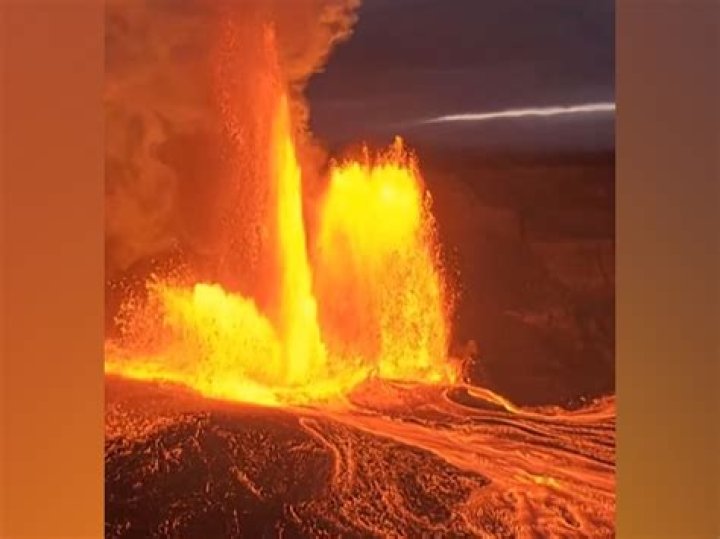
One of America's "Very High Threat" Volcanoes Keeps Quaking—Could It Erupt Any Day Now?

Emily Carr
Published Feb 22, 2026
As far as natural disasters go, volcanic eruptions are one of the most terrifying. The most recent major eruption in the U.S. was in 1980 at Mount St. Helens in Washington state. Fifty-seven people were killed, and 47 bridges, 200 houses, 15 miles of railway line, and 185 miles of highway were destroyed, according to the World Atlas. Fortunately, scientists were able to use data about the volcano's seismic activity to predict that an eruption was coming more than a month before the event, and evacuated homes in its danger zone the day before. Now, as seismic activity ramps up at one of the country's "very high threat" volcanos, many are asking if an eruption is imminent—and scientists think they have an answer. Read on to find out more.
RELATED: Major Hurricanes Intensifying, New Data Shows—Is Your Region in Harm's Way?
Seismic activity has increased at the Long Valley Caldera in California.
For the past four decades, scientists have been watching the Long Valley Caldera, a volcano about 250 miles north of downtown Los Angeles and 40 miles east of Yosemite Valley, because it's seen a noticeable increase in earthquakes and ground fluctuations over the years.
In May 1980, there were four magnitude six earthquakes in the area, and there has been increasing movement since then. These types of changes are often seen before eruptions, which put experts on high alert, according to the L.A. Times. However, the changes don't always mean an eruption is imminent.
Two theories could explain the activity, according to the San Francisco Chronicle: The volcano is either about to erupt or is cooling down. In a recent study published in the journal Science Advances, scientists from the California Institute of Technology say it's the latter. The increased earthquakes are due to gas bubbling up as the magma inside the caldera cools.
"We don't think the region is gearing up for another supervolcanic eruption, but the cooling process may release enough gas and liquid to cause earthquakes and small eruptions," Zhongwen Zhan, a geologist who worked on the study, said in a statement.
It's worth noting that volcanic earthquakes are different from tectonic quakes. The U.S. Geological Survey (USGS) writes, "As magma moves through the earth, it displaces and fractures rock along the way. This movement causes earthquakes that can be recorded with seismometers at the surface of the earth … They tend to be found at depths shallower than 10 km, are small in magnitude (< 3 [magnitude]), occur in swarms, and are restricted to the area beneath a volcano."
RELATED: 8 Best Natural Wonders Found in U.S. National Parks.
The volcano is considered a "very high threat."
In 2018, the USGS named the Long Valley Caldera a "very high threat," which is the highest risk category the agency assigns. Two other volcanos in the state, Mt. Shasta and the Lassen Volcanic Center, were also assigned to the category, along with 15 other volcanos in the U.S.
However, the assessment doesn't mean the volcano is more likely to erupt than others; instead, it's determined by the volcano's threat level to people if it were to erupt.
"Threat is defined as the combination of a volcano's hazard potential and the exposure of people and property to those hazards," writes the USGS. "In other words, a volcano that only erupts lava flows but doesn't have anyone living on it has very low threat, since even though there is a hazard (lava), there are no people or property at risk from that hazard."
The threat volcanos with the highest threats, according to the agency, are Kilauea in Hawaii, Mount St. Helens in Washington, and Mount Rainier in Washington. Long Valley Caldera ranked number 18.
RELATED: The Top 10 Safest Cities in the U.S., New Research Shows.
This is what would happen if the caldera were to erupt.
If the caldera were to erupt, the USGS says its impact would depend on the location of the eruption, its size, type, and the wind direction.
"Also, an eruption during the winter months could melt heavy snow packs, generating mudflows and locally destructive flooding," they write. Volcanic ash could shoot more than six miles into the air and travel hundreds of miles downwind, closing roads and disrupting communications and utilities like electricity and water for weeks or months.
Fortunately, the risk is low.
In order to determine the caldera's risk level, researchers from the California Institute of Technology used a 60-mile fiber optic cable to measure the seismic waves sent off by the caldera's earthquakes. They analyzed how long the waves took to travel through the material in order to determine what materials made up the areas within the caldera.
After finding that the volcano's magma chamber was separated from its crust by a layer of crystalized rock, they determined that the magma wasn't leaking upward, which could signal an impending eruption, explains the San Francisco Chronicle.
The USGS determined that the risk of the Long Valley Caldera erupting on any given day is about as likely as a magnitude 8 earthquake occurring along the San Andreas fault (aka "the really big one"). For now, it seems the area is safe.
RELATED:For more up-to-date information, sign up for our daily newsletter.
Juliana LaBianca Juliana is an experienced features editor and writer.Read moreFiled UnderNews • Science • Travel Advice • WeatherSources referenced in this article- Source:
- Source:
- Source:
Erupting Volcano Has Tourists Rushing to Hawaii
Apparently, volcano tourism is a thing—and a lot of people want to get up close to molten lava.June 9, 2023The World's Largest Active Volcano Is Erupting
An ashfall advisory has been issued by the National Weather Service in Honolulu.November 28, 2022Major Hurricanes Intensifying, New Data Shows
A few parts of the U.S. should be more prepared than ever. October 26, 2023The Smart Man's Guide to Spotting Counterfeit Wine
That $2,000 bottle of Bourdeaux might be worth $20. Here’s how to be sure it’s the real thing.April 13, 2017The 5 Best Light-Bodied Red Wines for Extending Your Summer
Don't let September ruin a killer party. August 25, 201717 Insanely Cool New Luxury Bicycles for Spring
Meet the bikes that cost more than a car.March 31, 2017Best Life Essentials
You deserve the best. Live life to the fullest with these ultimate essentials.October 21, 2016This Is the Safest Way to Store Meat
Don't let that filet set you up for food poisoning. February 7, 2018Here Are the 10 Wealthiest Cryptocurrency Millionaires Under 40
Including one guy who is only 24 years-old!February 7, 2018This Is the Safest Way to Clean Your Floors
Keep your floors clean and looking brand new with this easy tip. February 8, 2018