2024 Hurricane Season May Be 170% More Active—The States Most at Risk

Daniel Hoffman
Published Feb 23, 2026
Getting word that we're in store for a ferocious hurricane season may be an anxiety-inducing bit of news for many. But though we can't stop a devastating storm from coming ashore, scientists compile research and offer their outlook on how harsh the upcoming year will be so people can at least be prepared. Unfortunately, one of the latest forecasts now shows that the 2024 hurricane season might be nearly twice as active as the norm. Read on to see what the evidence says and which states are at the most risk.
RELATED: New Spring Forecast Shows Which U.S. Regions Will Be Warmer and Wetter This Year.
Ocean conditions are ripe for an above-average number of storms to form in the Atlantic.
After a highly active year in 2023, we might be in for even more tropical storms in the coming months. On April 4, Colorado State University released its long-term forecast for the upcoming hurricane season, predicting tropical cyclone activity in the Atlantic would be at 170 percent compared to historical averages due to mounting indicators.
"Sea surface temperatures in the eastern and central Atlantic are currently at record warm levels and are anticipated to
remain well above average for the upcoming hurricane season," the researchers wrote. "A warmer-than-normal tropical Atlantic provides a more conducive dynamic and thermodynamic environment for hurricane formation and intensification."
The forecast also acknowledged that it's likely current El Niño conditions—which historically help deter hurricane formation—will give way to La Niña conditions that remove protective wind sheer by late summer or early fall. The team added that the evidence gives researchers "above-normal confidence" that a "well-above average" hurricane season is likely.
RELATED: Widespread Blackouts Predicted for 2024—Will They Hit Your Region?
Scientists expect a sharp increase in named storms and major hurricanes.
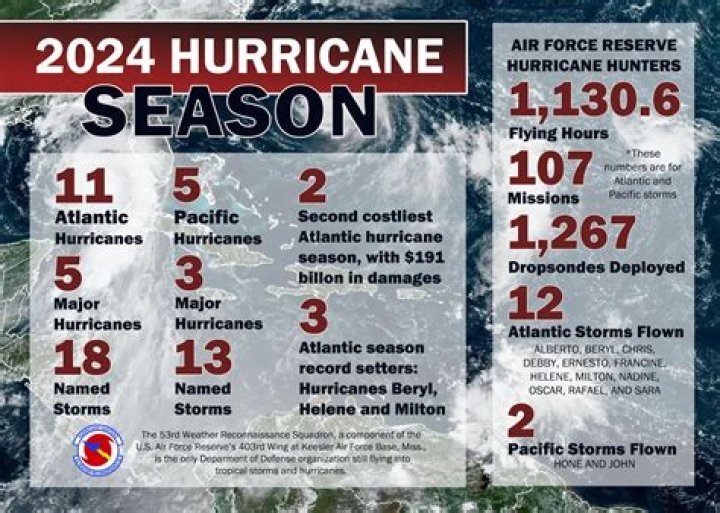
Because of the conditions, the forecast also says we can expect many more storms to form when hurricane season begins. The outlook predicts 23 named tropical storms will form, marking a drastic increase from the 13 that formed last year, Fox Weather reports. It also beats the historic average number of 14.4 named storms.
The forecast also calls for 11 hurricanes to form in the Atlantic, up nearly double from 2023, when six were predicted, and besting the running average of 7.2. And they won't just be greater in number: They'll also likely be stronger, predictions saying five major hurricanes will be category 3 or stronger. This is more than double the two predicted in 2023 and higher than the 3.2 historical average.
RELATED: How New "Extreme" Thunderstorms and Wind Are Increasing—And Affecting Where You Live.
Many states saw a significant increase in their chances of being hit by a storm.
The latest data also shows which areas could be most affected by a highly active hurricane season. Researchers said there is a 29 percent chance that a named storm wwill pass through New Hampshire, while Rhode Island and Maine have a 32 and 34 percent chance, respectively. Meanwhile, New Jersey, Delaware, and Connecticut all have a 35 percent chance.
There's also a 41 percent chance that New York will see at least a tropical storm, while Maryland has a 47 percent chance. But odds creep up even higher in the south, with Virginia at 65 percent; Mississippi at 72 percent; South Carolina at 76 percent; and Alabama at 78 percent.
The most at-risk states all have percentages of 80 or more. They include Texas with 80 percent; Georgia at 82 percent; Louisiana at 84 percent; North Carolina at 85 percent; and Florida, which has a 96 percent chance of getting hit with a named storm this season. Notably, Louisiana, Texas, and Florida have the highest likelihood of being hit with a major hurricane, at 23, 25, and 44 percent, respectively.
In every case, this represents a double-digit percentage increase from the climatological averages in each state, ranging from 10 to 20 percent above each's norm, per Fox Weather.
Scientists still say anything is possible but remain confident in their forecast.
Long-term forecasts provide a basic outlook on what could happen in any season. However, even researchers admit that nothing is set in stone.
"Obviously there's still a lot that can change," Phil Klotzbach, the author of the forecast, told USA Today. But he added that even if ocean temperatures reduce their spring and summer warming rate to the slowest ever recorded, it would still be the second warmest ocean surface temperatures in four decades.
The other major consideration is that while forecasts can predict the number of storms, they don't always provide information on landfall.
"[It] doesn't tell us anything about where those storms may move," Robbie Berg, a hurricane specialist at the National Hurricane Center, told USA Today. "So maybe we'd get lucky and have them stay out over the Atlantic. But we don't know that, and that's why every year we still have to be prepared, because whether it's 10 storms or 20 storms, where they form, where they move is what's critically important."
Zachary Mack Zach is a freelance writer specializing in beer, wine, food, spirits, and travel. He is based in Manhattan.Read moreFiled UnderNews • Science • Summer • WeatherRead This NextExperts Warn of "Explosive Hurricane Season"
Ocean temperatures are reaching record highs—and could be fuel for storms.March 13, 202410 Places With "Extreme Winter Weather"
Many midwestern counties are the most vulnerable, according to a new study.February 12, 2024How "Extreme" Storms Will Affect Your Region
Straight-line winds impact parts of the United States in different ways.November 25, 2023Major Hurricanes Intensifying, New Data Shows
A few parts of the U.S. should be more prepared than ever. October 26, 2023Widespread Blackouts Are Predicted for 2024
Plus, how to stay safe if the power goes out this winter.January 22, 202410 Riskiest U.S. Cities for Natural Disasters
How to avoid earthquakes, wildfires, floods, hurricanes, and tornadoes.September 30, 2023Why You Shouldn't Trust the Farmer's Almanac
Here's what to look at instead, according to meteorologists.October 29, 2023Where Will It Be Warmer and Wetter This Year?
Several parts of the country are going to see a dramatic change from the cold.February 16, 2024"Extended Winter" May Keep Things Cold
Find out what their 2024 spring forecast says you can expect where you live.February 2, 2024The Smart Man's Guide to Spotting Counterfeit Wine
That $2,000 bottle of Bourdeaux might be worth $20. Here’s how to be sure it’s the real thing.April 13, 2017